

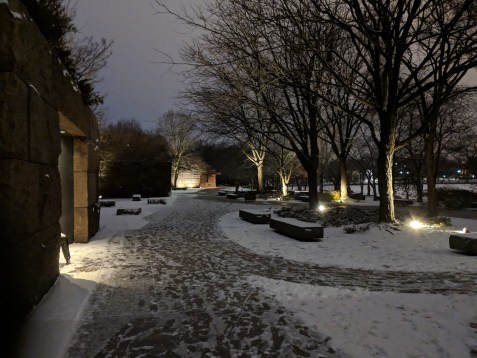
On this cold night with some snow on the ground, I need to understand why I’m here. A little dose of civic religion helps me center my ambitions and there’s no better place for me to tap this well than the FDR Memorial at night.
20 years ago was the first time I learned about a President other than Washington, Lincoln, JFK, HW Bush, or Clinton. And by learn, I mean more than just a name, but to be honest, as I reflect now, these may have been the only names. Men of myth for having ascended into our pantheon as deity or martyr or in the case of the all too human Bush and Clinton – looming large in the worldview of a child the way that public figures usually do.
In 1998, fourth grade, I was assigned to make a timeline of a person, I think. I forget the exact parameters.
What I do remember was pulling the book out of a bookshelf. Bronze bordered with a photo of his beaming face out of a car, in front of a crowd. Titled just “FDR” – I think.
A new era of American history opened and standing astride it, he was like a superhero colossus of real life. As a young Jew who loved Indiana Jones movies – here was the real man who beat the Nazis.
The country was failing and people were hungry and homeless and HE provided for them.
I think that this was my first awareness that someone could become paralyzed, yet that didn’t diminish him one bit. The concept of losing such a core ability and learning its loss didn’t hold one back one bit.
And above all else, he was just a man. Not a myth, deity, martyr, but a hero nonetheless. As a ten year old steeped in movie heroes – the idea of a real person as a real hero was nearly transcendent. There was definitely internal mythologizing involved but at that moment, Franklin Delano Roosevelt was locked in as the meter and benchmark.

The FDR Memorial is ironically quiet for a grand man as The Lincoln Memorial is ultra-grand for a magnificent but quiet man. The memorial sprawls across walls, reliefs, bronze sculptures, and waterfalls that start orderly and then cascade in a beautiful manner as WWII strikes and a new more confusing world is born. Quotes are spread throughout, touching at an an optimistic yet aware sense of the American soul, and braille is spread throughout, with a mind towards inclusiveness. I came tonight after a constant but light and pleasant snow. It graced the temples of sculptures and crunched underfoot.
I became a Democrat early on.
Maybe it was because Bill Clinton was President as I grew up. Maybe it was because I was raised to be compassionate. Or maybe my curiosity about the world was encouraged at a young age and a faith in coexistence became permanent. It could be growing up in a perfect little slice of suburbia in that cradle of liberalism and revolution – Massachusetts. Whatever it was – FDR came at the right time to be my North Star.
Care for the poor, enemy to tyrants, champion of the world to be United.
Do good in the world, lead when you can, trust your community, stand up to tyrannic evil, be optimistic and of high spirits, never stop seeking for new solutions. Those are the lessons imparted to us by FDR. Or maybe just to me. Nevertheless, for the past 20 years, this has been the heart of what guides me.

The cold gives me a slightly delusional giddy feeling. Like I said, the snow is crunching underfoot. At night, perfectly aimed lights illuminate the memorial’s emotional high points. It is laid out to tell the story for his Presidency, the fourish terms, from the Great Depression through the New Deal to World War II to his legacy – but more importantly – his wife Eleanor Roosevelt leading his legacy, the UN. I’m alone tonight and wander through and speak out loud. To history? To ghosts? To him?
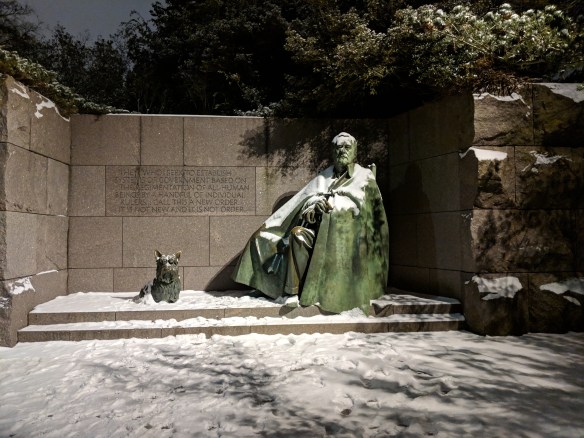
After wandering through a grove of pillars, covered by abstract reliefs depicting the breadth of the New Deal’s impact, and in braille, I come to a larger than life sculpture of him, in a cape, with his dog Fala.
If you’re “in politics” and not an eager student of history, you’re approaching things wrong. I pursued my own narrative of engagement and agenda of change – interning on an ill-fated Massachusetts gubernatorial campaign, jumping on the ballot myself in achievement and (at then) heartbreaking loss in student government. Early on, to be honest, I’m not sure what first inspired the first step to start doing things but it just seemed natural. But now, with the benefit of reflection, its obvious that the boy who wanted to be a superhero when he grew up found one in politics and that politics was the way to do good, as he did.
But of course, neither part is that simple.
I worked my butt off in some student government offices with persistence and accessibility, only to then lose office in popularity contests. I doggedly pursued later races and then squandered opportunities to make change – treating the win, not the job, as the goal.
My self-imposed ideas of “moderation” ran up against the, I assume, sincerely held beliefs and actions of those more radical. And I learned the realness, not the dusty history of events, of our nation’s sins as I learned to respond and the reasons behind the views of others. Misfortune was not something that just happened, it happened because of the world our country makes or doesn’t make. History was not just knowing what happened, the archetypal narrative, but the how and why.
Truman received my admiration by proxy and that the same time my horror at US action in Latin America during the Cold War pushed me towards international development as a remedy and course of action. Yet, I argued in defense of the dropping of the Atomic Bomb in a college freshman course. Looking back now, I know I spoke with the naive confidence of a fortunate one. FDR receded in favor of the present. College Democrats and Obama and the relentless drive towards my future and an opening world and the thrill of shaping my course all took the lead in guiding my politics.
Two women, bundled up and speaking Spanish round the corner at the Memorial. They’re as surprised as I am to see anyone at night in this cold but then they ask me to take their picture. They love Fala. In my reflective state, I’m looking to have a conversation but they’re hesitant. I forget exactly but when we begin moving in and out of Spainglish, we all loosen up.
They live in Miami and are originally from Mexico and Nicaragua if I recall correctly. They don’t know who FDR is and I share a brief history lesson of an admirer and appreciate their attentiveness. We share this ground and memorial, whether due to hero worship or Fala’s timeless charms. We’re all American after all.
Politics is hard. And not in the “politics ain’t beanbag kind of way” but when you first choose it as a career – it doesn’t pay, doesn’t have sympathy for you, doesn’t have natural entry points, isn’t consistent, and doesn’t care about your passion and crazy ambition. It privileges the privileged and the privileged can often better afford to pay their dues. Yet, the world isn’t fair or just either but through it all, an animating vision can keep you moving day by day until you can reach a plateau of comfort. Plus, it’s also messy.
I don’t know when I first learned about Japanese Internment or FDR’s lack of pressing concern for the Holocaust but it happened. A man who built all of his image on an idea of compassion for his fellow man only extended that compassion at times to his fellow American – narrowly defined, and the world – broadly defined.
Pilgrimage may be a heavy word for it but when I made a pilgrimage to Hyde Park in the Hudson Valley – the site of his home, Presidential Library, and grave – the cardboard hero of history from the fourth grade became deeper and more.
He was a hoarder, at least in a sense. His Hyde Park home is covered with the accumulated knick-nacks of a wealthy man, spoiled in his youth, but curiosity encouraged. Model boats, childhood mementos, paintings, cover every bit of space. He’s also immensely afraid of fire due to his paralysis and fixtures throughout his house depict his precautions. The scale of the property drives home how wealthy he was but walking through these fields and woods on a perfect summer day, visiting his and Eleanor’s grave, its a communing with history.
It was my last summer before I moved to Washington DC to attend my dream graduate school in foreign policy and the opportunity to act on my values in a real way had never felt so possible. And at this moment, FDR was a real person, not a legend. And real people deserve scrutiny in the same manner we must always self-scrutinize on why we believe what we believe, and why we do what we do, and why we believe in what we do and do what we believe.
When FDR becomes a man, Eleanor rises to a higher level. With added depth comes an increased understanding of history and her moral leadership, sacrifices, their partnership, all become essential in understanding how he could do what he did. The times he didn’t heed her counsel also become starker.
It is still hard for me to fully expunge my disbelief at the cowardly, racist, and dictatorially unconstitutional act of imprisoning Japanese Americans. The more and more I read about FDR’s management style and interpersonal relations, its kind of clear that he could be an obtuse and withholding jackass. And of course, he cheated on Eleanor over and over.
He acted on the privilege he grew up with and without the humbling of his paralysis and his partnership with Eleanor – he may have lived his life as a dilettante. His character flaws and sins show who he almost was but yet, his story turned otherwise. He was sincerely and fully committed, with all ounce of his being and measure of his talent – to the point of dying for the country. He carried the Great Depression and World War II and the country’s hopes and pain on his shoulders.
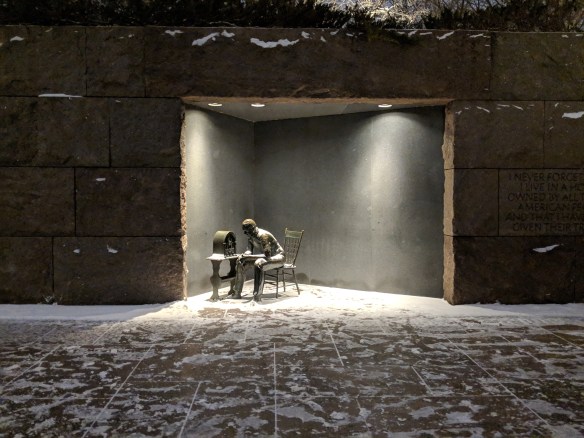
Here I am at the end of the Memorial, where in warmer months the chaotic waterfall flies of stones, letting loose tremendous energy in a free spring. Earlier in the memorial, the waterfalls, meant to evoke the Hudson Valley, are more orderly but as you progress through the narrative of his Presidency – the waterfalls loosen up more and more. Also at the end, a statue of Eleanor stands, lit up and lifelike in an alcove, with text honoring her founding leadership with the UN and human rights. Quotes line the walls with the Four Freedoms, declared by FDR, as those that people everywhere in the world ought to enjoy, overlooking all.
Freedom of Speech
Freedom of Worship
Freedom from Want
Freedom from Fear
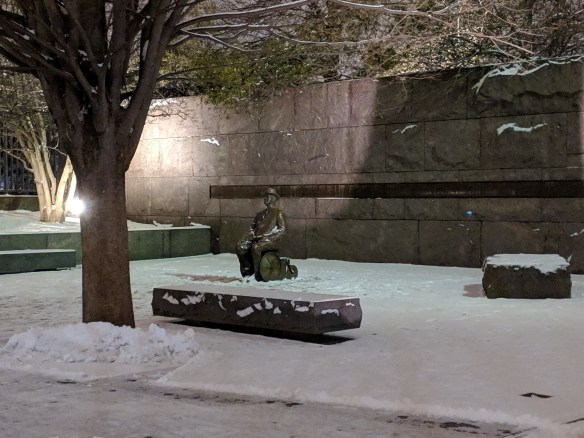
On my way out, a crowd of school children are coming in. They all pause to take photos with a statue of the President, just to the right of the entrances. Its life-size, human, him in his wheelchair and appearing even smaller due to its remove from the grander trappings in the rest of the memorial.
Those of us with unlimited belief in our potential should do well to view great lives tied above all to the service of others. An understanding of each of our fragility shows you the virtue of seeking solutions above all else, simply put – you have to try because what else is there. We’re ultimately human, but with the guidance of loved ones, an at least base understanding of our morals, welcoming the future with possibility, and a persistent faith in oneself and one’s abilities – maybe each of our actions may echo in history.
That man, that grand man, that spoiled rotten yet compassionate person, that warrior for universal freedoms who betrayed them for his fellow Americans, that voice for an optimistic belief in a shared better future for all – maybe lessons on how to live and not to live, how to lead and care, are the main thing we can expect from someone who was ultimately a human.
 Not that fox news
Well written self-reflective narrative; and yes we are human after all with the good intentions and righteousness and with the humbling mistakes and fearful choices. You are a wonderful thoughtful man who is passionate about politics and doing what’s right. May your life reflect your inner light.
Love you, Patty
Thanks so much Patty for taking the time to read and thoughtfully engage. As always, I’m grateful for your affirmation 🙂